
#32: The Kind That Rises
On sourdough bread, ancient fermentation, and what it means to steward something alive

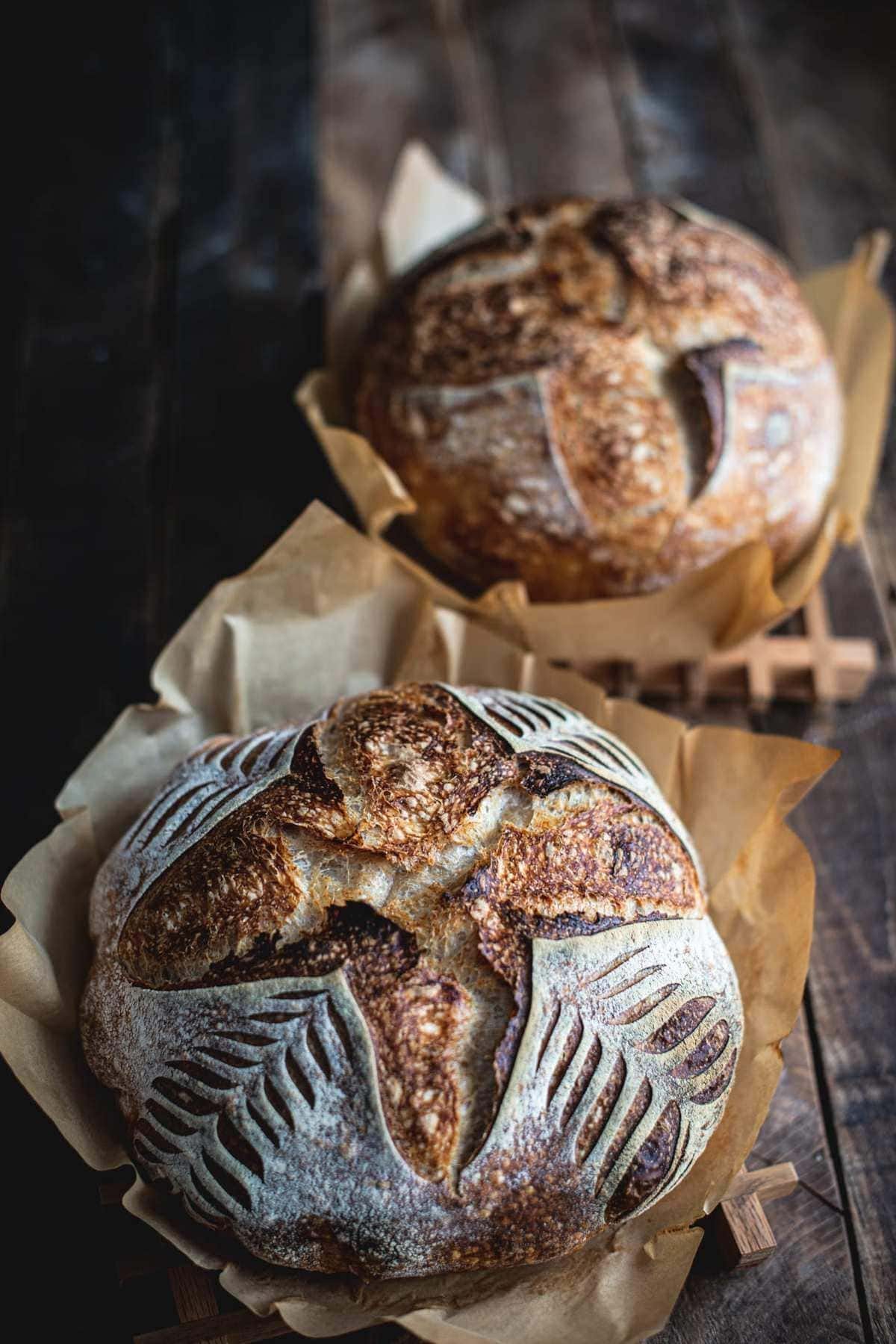
I didn’t plan to ask for the starter. I stopped in Asheville on the way home from somewhere I can no longer remember, found my way into a bakery called Owl, and sat down with a loaf and a coffee. The place was filled with people who weren’t in any hurry, who were leaning across small tables, tearing at crusts, not talking about anything in particular. The bread was extraordinary, alive like bread from the grocery store had never been, had never even hinted at being.
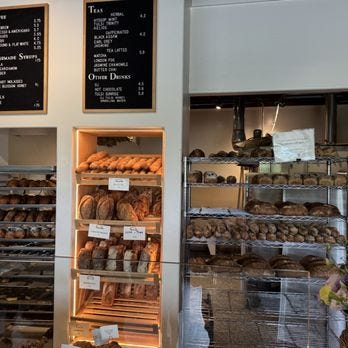
At this point, I didn’t know the first thing about making bread. I’m not sure what came over me, but before I left, I walked up to the counter and asked if they would give me some of their starter.
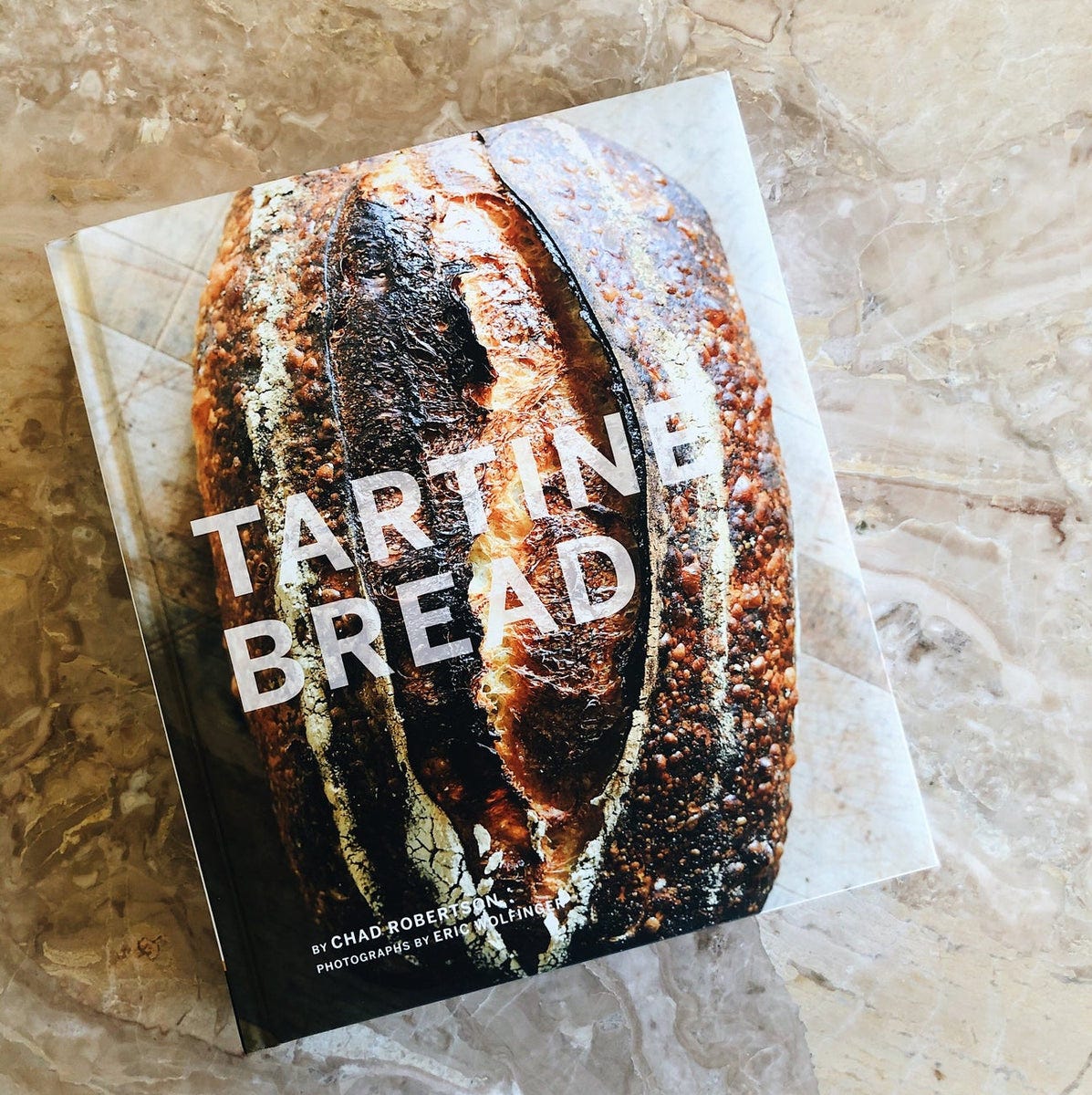
They did. I carried it home like something fragile, which it was. I ordered a book. I bought a banneton, a bread knife, a kitchen scale, glass jars. And then, with the certainty of a complete beginner, I started learning to do one of the oldest things humans have ever done.
That was nine years ago. I bake every weekend now. I give loaves as gifts. I have failed more times than I can count: dense bricks, flat disappointments, loaves that came out of the oven and looked beautiful until they were cut and revealed a gummy, under-proofed interior. I have learned to read dough by touch, to feel the difference between a mass that needs more time and one that’s ready. The starter sits in my refrigerator between sessions, waiting. My family eats the bread and doesn’t particularly think about it, which is exactly right. Lately, a lot of the dough has been becoming pizza.
I have been thinking about it. Where this all came from. What I am actually doing on Saturday mornings when the house is quiet, and I am standing at the counter with flour on my hands. How deep the roots go.
The Crenshaws’ Yard
I tasted unleavened bread before I ever tasted sourdough.
I was around ten years old, growing up in rural middle Tennessee. The Crenshaws were hosting Vacation Bible School that summer through our church, Winchester First United Methodist, and their property was perfect for it: a big white house set on a big piece of land, the front yard arranged with booths and activities, the whole thing shaded by old trees that made the Tennessee heat tolerable. Eddie Crenshaw was my age, and we moved through the booths without much attachment to any of it.
One of the booths was teaching us to make unleavened bread. They were reading from Exodus. The story moves fast: the Israelites fleeing Egypt, Pharaoh’s army bearing down, no time to let the dough rise. They baked what they had, flat and dense and unfermented, and ran. The holiday of Passover still commemorates this each year, and we learned that the matzah on the Seder plate is more than food. It is memory, the shape of urgency made edible.
The bread we made tasted nothing like the bread I knew. I was a child raised on leavened everything: sandwich loaves, dinner rolls, the soft and pillowy American wheat-bread experience. The unleavened bread was flat and dense and slightly sour, with a cracker-like texture that registered as alien.
I did not love it, but I did not forget it.
Getting curious, I learned that bread is older than writing, older than cities, and older, in its earliest forms, than agriculture itself.
Archaeological evidence from a 14,000-year-old Natufian site in present-day Jordan shows that hunter-gatherers were grinding wild cereals into flour long before anyone had thought to plant a field. They were making flatbreads over fire. They were making the Crenshaws’ VBS bread, the Passover bread, the same dense unleavened thing that has been part of human life since before history had a way to record itself.
For most of the millennia since, the staff of life was made by hand from only four ingredients: flour, water, salt, and a sourdough culture of wild yeast and bacteria. What changed everything, what separated flatbread from a risen loaf, was an accident. Someone left dough sitting out and wild microbes drifted in from the air, from the grain itself, from the baker’s hands. The dough began to bubble. They baked it anyway. Turns out this is the same way humans discovered alcohol, too.
What came out of the oven was different: lighter, more complex in flavor, more alive.
Concrete archaeological evidence of sourdough bread was discovered in 1976 in the village of Twann in Switzerland, dating to roughly 3,700 BC. Workers who built the Egyptian pyramids received the bulk of their calories from sourdough bread. Pliny the Elder (now also the name of a world class beer), writing in 77 AD, described Roman bakers who leavened their loaves by reserving a portion of fermented dough from the previous day. That is the same technique, in its essentials, that I use every weekend in my kitchen in South Carolina.
It’s important to understand that the leavened and unleavened divide has never been merely culinary. It carries theological and symbolic weight that even a ten-year-old at a church camp in Tennessee could feel without being able to name it. Unleavened bread in the Exodus narrative signifies rupture, haste, the world breaking open, and demanding you leave before you are ready. Leavened bread in other traditions, the communal loaves and the risen Eucharistic bread, carries warmth, patience, and completeness. Fermentation requires time; it cannot be rushed, and a dough that is not ready to bake will tell you, if you know how to listen.
What is actually happening inside a sourdough starter is more complicated than most bakers realize, and more beautiful.
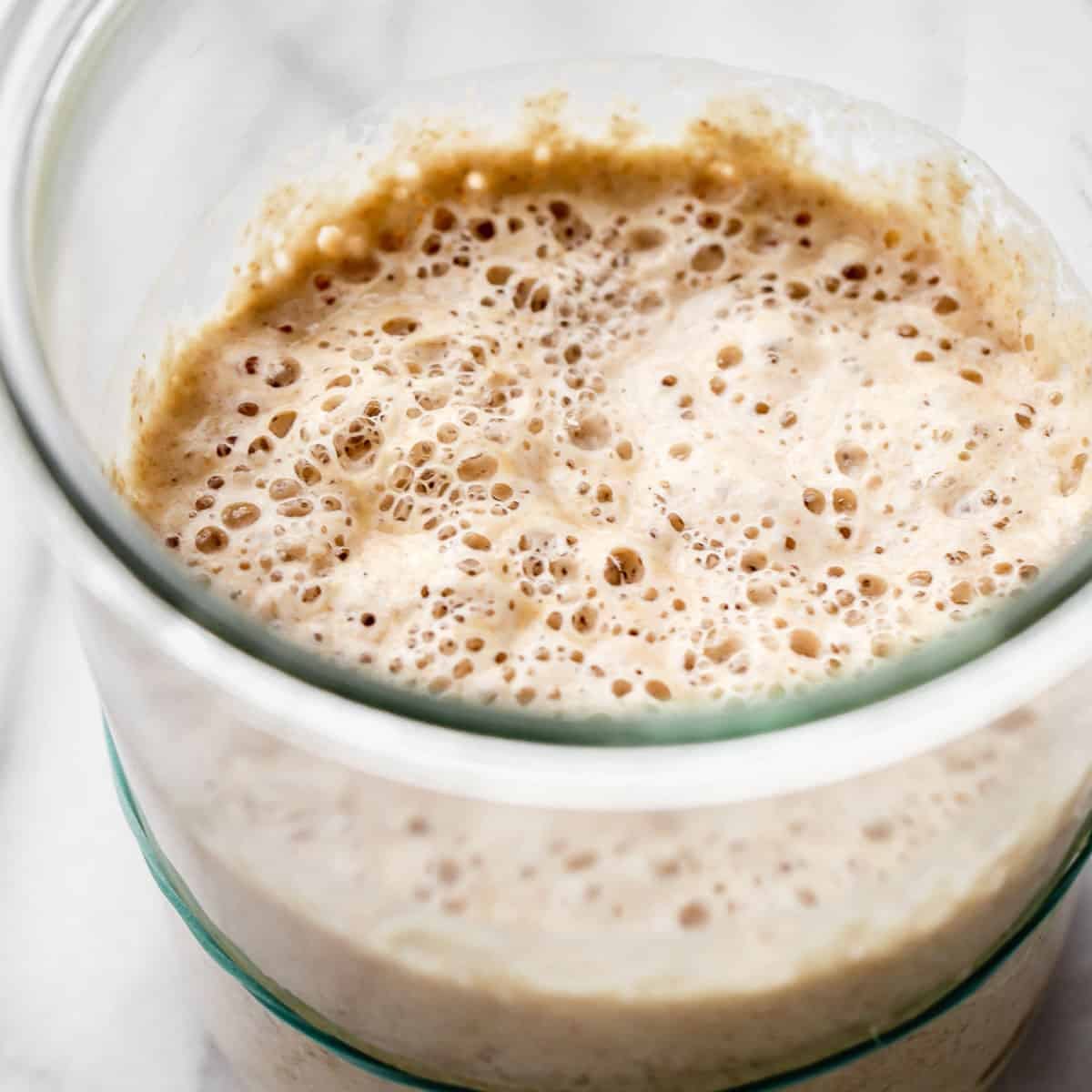
Most people assume a starter is primarily wild yeast. It isn’t. Wild yeast is far outnumbered by lactic acid bacteria in a mature sourdough starter. Lactic acid bacteria outnumber yeast cells by roughly 100 to one. What you are maintaining in that jar in your refrigerator is not, like many believe, a simple colony of yeast. It is a stable, self-regulating ecosystem, a community of organisms that have reached a kind of ecological equilibrium, where each member of the community feeds the other, and the whole becomes more resilient than any single organism could be alone.
The yeast breaks down starch into sugars and metabolizes some of them. The lactic acid bacteria ferment the remaining sugars the yeast cannot use, producing carbon dioxide and acid as byproducts. The byproducts of bacterial fermentation are in turn metabolized by the yeast, which produces the carbon dioxide that leavens the dough. Yeast and bacteria have been living together in this mutually beneficial arrangement for millennia, and neither can fully thrive without the other.
The microbial communities in a sourdough starter are most similar to those found in the flour itself. The bacteria and yeast arrive primarily with the grain, though some come from the baker’s hands. Your starter is partly a portrait of you. Of your kitchen. Of the air in your home, the flour you prefer, and the temperature you keep the house in winter. Researchers have found that starters from the same region can share microbial similarities, a kind of geographic signature, the bread world’s version of what winemakers call terroir. The wild character of your loaf is, in a literal biological sense, of your place.
The Owl Bakery starter I carried home had its own history before I touched it, shaped by the Appalachian air, the hands of bakers I had never met, the microbial fingerprint of a kitchen where people had been doing this work for years. My kitchen has been reshaping it ever since, slowly, with each feeding, each ferment. What lives in my refrigerator now is neither purely Owl Bakery’s starter nor purely mine. It is something that did not exist before.
The lactic acid bacteria do more than leaven and flavor. The long, slow sourdough fermentation breaks down phytic acid in wheat, a compound that ordinarily binds to minerals like calcium, magnesium, iron, and zinc and prevents the body from absorbing them. Commercial bread leaves these antinutrients largely intact. In sourdough, the bacteria effectively pre-digest the flour, releasing nutrients that would otherwise pass through you. For people with non-celiac gluten sensitivity, this partial breakdown of gluten proteins can make sourdough significantly easier to digest. The fermentation also slows the breakdown of starch, resulting in a lower glycemic index and a more gradual release of glucose into the bloodstream.
None of this was understood until very recently. For most of human history, bakers knew that sourdough was better, more complex, more digestible, and better preserved, without knowing why. Science has only caught up to the intuition.
For most of human history, every loaf of bread that was ever baked was a sourdough loaf. Every loaf consumed by Pharaoh’s court. Every loaf pulled from the communal ovens of a medieval village. Every loaf baked by frontier families who guarded their starter like a possession second only to the Bible. The slow ferment was the only method that existed.
Then, in 1868, a Hungarian immigrant named Charles Fleischmann arrived in Cincinnati with something in his pocket: a standardized, compressed cake of commercial yeast. He and his brother built a yeast plant and patented a product that promised excellent leavening power, consistent quality, and great-tasting bread. At the 1876 Centennial Exposition in Philadelphia, they set up a Vienna Bakery booth where the smell of fresh bread reached the millions of visitors who passed through. By the time the exposition closed, the country had decided.
Commercial yeast changed bread in ways that were immediately appealing. The rise was faster. The results were more predictable. You did not have to maintain a starter, did not have to understand fermentation, and did not have to develop the sensitivity to know when the dough was ready. Bread could be made in hours instead of days. By the early twentieth century, it could be made in factories, in continuous industrial loops, stamped into identical loaves and wrapped and shipped across the country.
Sourdough, the bread of the pyramids and the Roman legions and ten thousand years of accumulated human knowledge, nearly vanished from American life within a single generation.
What we gave up, we did not entirely understand at the time. The complex flavor that comes from long fermentation. The nutritional transformation that happens when bacteria have hours to work on the grain. The microbial ecosystem that took millennia to evolve. Industrial bread is faster, cheaper, and more uniform than sourdough. It is also, in most cases, a nutritionally inferior product wrapped in the shape of something that was once extraordinary.
The sourdough revival of recent decades, the Tartines and the Owl Bakerys, and the countless home bakers who took up the craft during the pandemic, are participating in a reclamation, reaching back through the industrial rupture to recover something that was almost lost.
In our home, the process usually begins on Friday evening. I pull the starter from the refrigerator, my portion of the Owl Bakery culture now nine years into its new life in my kitchen, and I feed it. Fresh flour. Water. I let it work overnight.
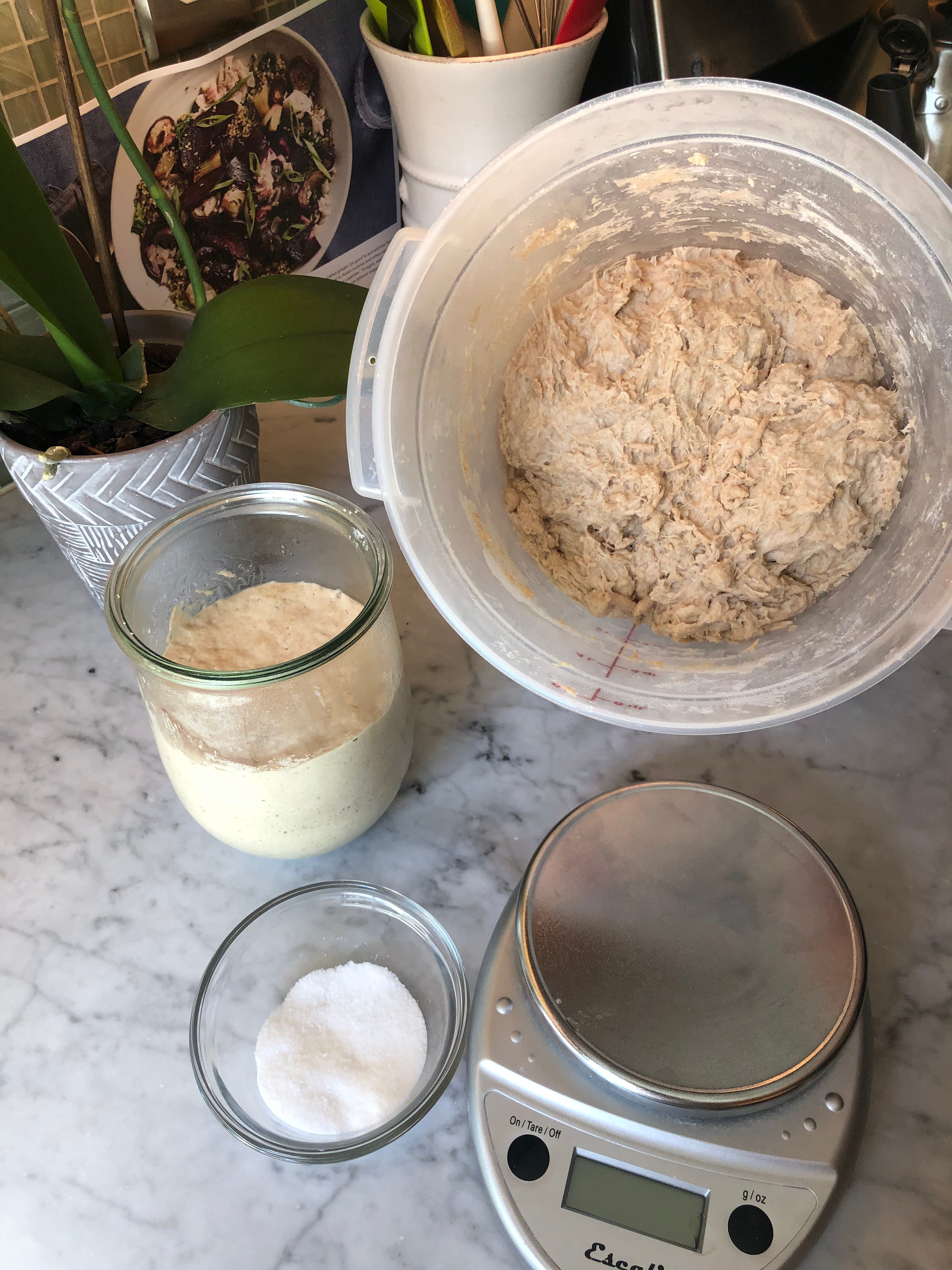
By Saturday morning the starter is alive, doubled in volume, bubbling. The float test confirms what my eyes and nose already know. I mix the dough by hand. Bread flour, water, the active starter, salt. What I am handling at this stage is not dough yet. It is a shaggy, slack mass that tears if you pull it, that seems unlikely to ever become anything beautiful.
Then the long fermentation begins. For the next three to four hours, I perform a series of stretch-and-fold sequences. Every thirty minutes, I pull a portion of the dough up and fold it over itself, rotating the bowl. Between folds, the dough sits. The bacteria and yeast are working the whole time, producing acids and carbon dioxide, transforming the molecular structure of the flour, building complexity that no amount of kneading could manufacture.
This is where bread becomes a practice in attention. You cannot rush or control the bulk ferment. You can only watch for the signs that it is ready: a thirty to fifty percent increase in volume, a dough that holds its shape when you handle it but still has a slight jiggle, like something alive, which it is. You learn to read these signs from the dough itself.
This takes years. I am still learning.
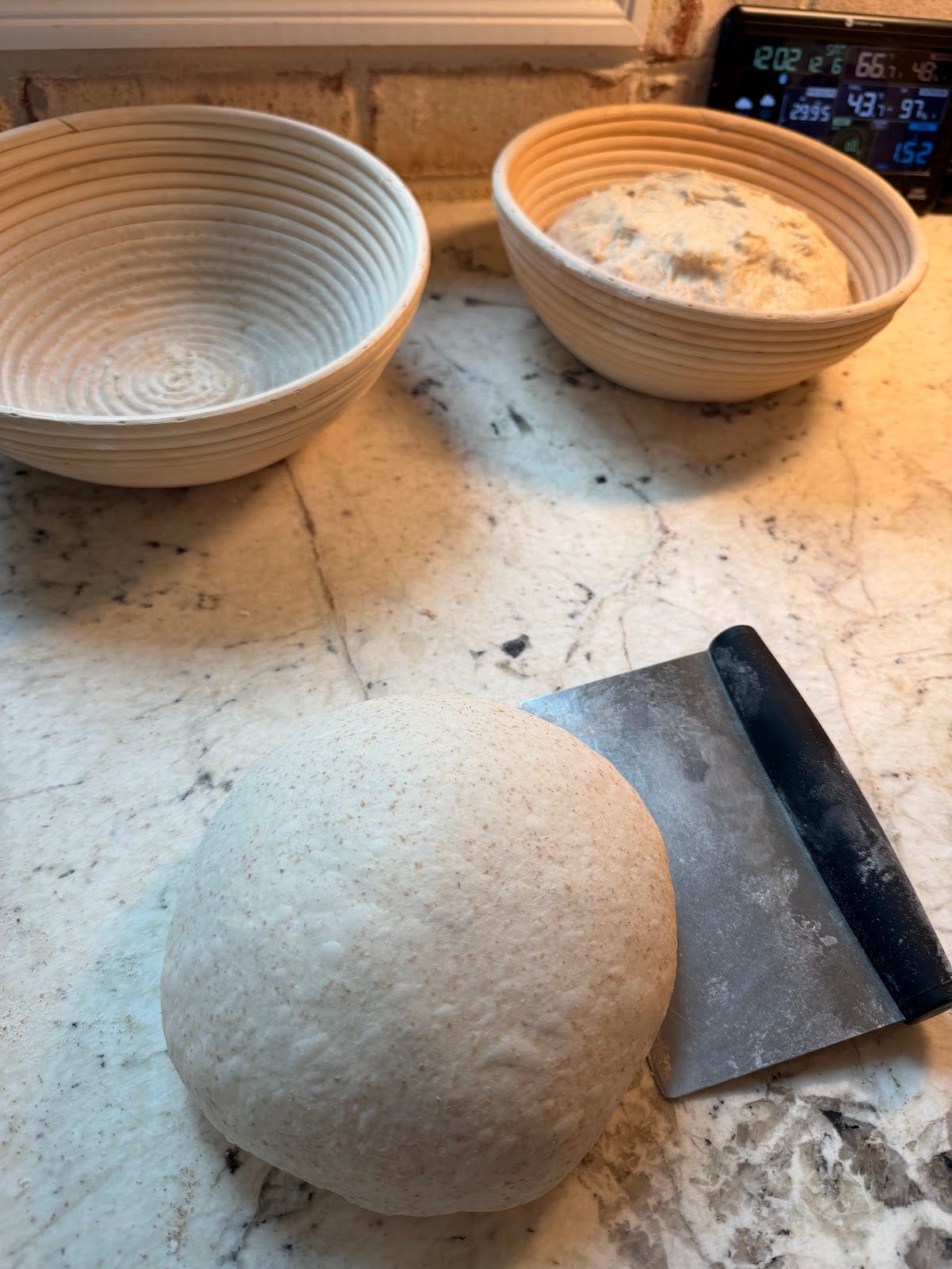
After shaping, the dough goes into the banneton and then into the refrigerator for a cold overnight proof. The cold dramatically slows the fermentation, extending the time the bacteria have to work, deepening the flavor in ways that a same-day bake cannot produce.
Sunday morning. The Dutch oven preheats at 500 degrees. I pull the dough from the refrigerator, turn it out onto a piece of parchment, and score it with a bread lame. A single confident slash, or an ear-shaped cut along one side, or sometimes an intricate pattern if I am feeling patient. The scoring controls where the loaf opens as it bakes. An unscored loaf will burst unpredictably. The score is the baker’s intention written into the crust.
When you pull a finished sourdough loaf from a Dutch oven, it makes a sound. A hollow knock when you tap the bottom. A crackling that audibly signals the crust is doing exactly what it should. You set it on a wire rack, and you wait, thirty minutes at minimum, because cutting into a hot loaf stops the interior from finishing its set, and patience here is its own reward.
The first cut is still, after nine years, a ceremony.
I have a beginner’s Zen practice. Multi-day sesshins and semi-regular sitting cultivate an attention that comes from years of learning to be where you are without trying to be somewhere else. People sometimes ask how I find the time for all of this: the practice, the running, the bread, the medicine, the building of businesses. I do not have a satisfying answer, except to say that these things do not feel like costs. They feel like the same thing, approached differently.
Sourdough baking is a practice in the Zen sense that it demands presence. You cannot be somewhere else while you are reading dough. The gluten development under your hands, the slack of a bulk ferment that has gone too long, the tension that builds in a properly shaped loaf. These are sensations that exist only in the moment of contact. A timer can tell you when to look, but cannot tell you what you see.
There is no perfect recipe for sourdough, because the variables are never the same twice. The temperature of your kitchen changes with the seasons. The flour has different protein levels from bag to bag. The starter is in a different phase of activity depending on when it was last fed. Every bake is a dance with conditions that are slightly different from the last time, and the bread is your answer. Good baking, like good medicine, is pattern recognition across many iterations. You are learning to read a system that is always moving.
What this teaches you, over years, is something like humility. The dough does not care about your schedule. It is ready when it is ready. You can influence the conditions: temperature, hydration, time, starter percentage. You cannot override the biology. You work with it, or you get a bad loaf.
I find this clarifying. In a life that involves running a behavioral health practice, building software for physician-owned practices, raising children, keeping up a running practice, writing, in a life organized around output and accomplishment, sourdough is the one domain that will not be optimized. It just takes the time it takes.
When I walked out of Owl Bakery with their culture in a container, I was carrying an organism with a biography I did not know. Wild yeast and bacteria that had established themselves in that kitchen, drawn from the air, from the grain, from the bakers’ hands, and reached equilibrium over years of daily feeding. Before that, those same strains existed somewhere else. The flour came from a particular mill, from particular wheat fields, from a particular climate. I’m not sure where their starter actually originated. Some famous starters have been passed down through generations. Carl Griffith’s 1847 starter is an exceptional example, passed between bakers for over a century. Some are claimed to be older still.
My starter is not that old. It is nine years old in my hands, which is old enough to have become something. It has been fed in my kitchen, in my water, breathing my air, shaped by my habits and preferences. It has traveled with us when we have been away for more than a week. It will survive me if I treat it right.
I intend to give it to my children.
This is the thing that most separates sourdough from every other kind of cooking I do. A recipe can be passed down. Knowledge can be passed down. A living starter is something else. It is a transfer of biological continuity, a living thread connecting whoever uses it across time. When my children feed this starter, they will be feeding the same organisms that Owl Bakery fed, that I have fed every week for nine years. The microbes will adapt to their kitchens, their hands, their local grain. The starter will become theirs in the same way it became mine. The lineage holds.
I have been a physician for my entire adult life. I have thought hard about what it means to take care of people, what it means to nourish health rather than simply treat disease. Sourdough has become, unexpectedly, one of the places where I live that understanding most concretely. I am feeding something that feeds my family. I am stewarding something that will outlast me. I am participating in a practice that stretches back to the Crenshaws’ yard in Tennessee, to Owl Bakery in Asheville, to the pyramids at Giza, to someone in the Fertile Crescent ten thousand years ago who left dough sitting in the open air and came back to find it transformed.
None of this was planned, and in life, the best things rarely are.
On Saturday evening or Sunday morning (depending on a cold final proof or not), when the bread comes out of the oven, my family does not necessarily gather around. They are doing whatever they do, but eventually someone wanders into the kitchen, sees the loaf on the rack, and there is a moment, always the same moment, where they stop. The crust is deep brown, crackled, beginning to make its cooling sounds, and our kitchen smells like something ancient, heavenly.
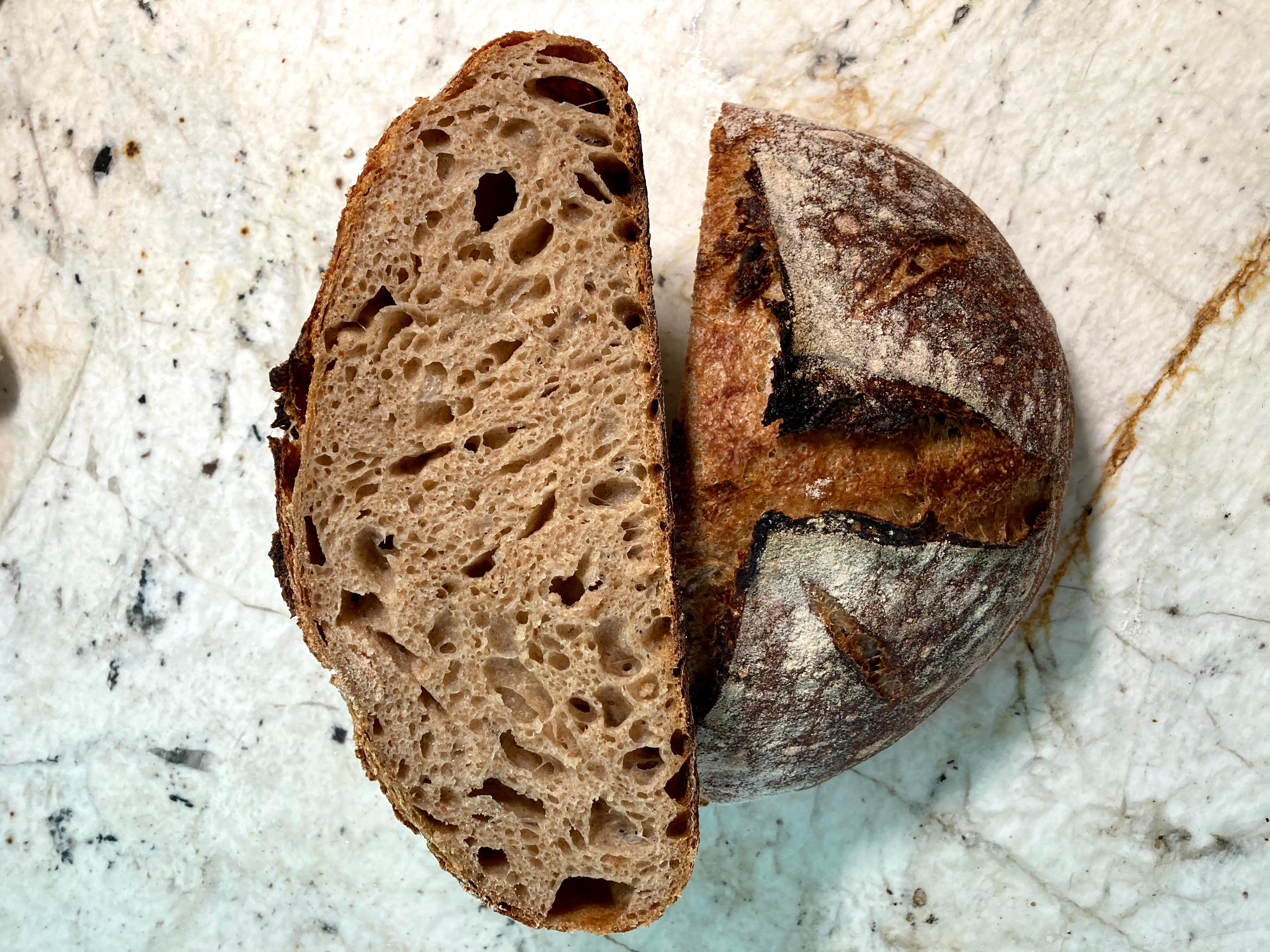
We wait the thirty minutes, usually, sometimes less. I cut the first slice, and the interior reveals itself: an open, irregular crumb, the holes that formed when the bacteria and yeast did their work, a slightly glistening surface that catches the light. The crust shatters when you bite into it. The flavor is complex in the way that simple things, done patiently, become complex. A mild acidity. A depth that grocery store bread, whatever it advertises on the package, cannot produce.
My kids eat it without thinking much about what it is. Which is exactly the way it should be. They are eating something made from four ingredients by a process billions of years old, in a kitchen in South Carolina, from a culture that began in the mountains of western North Carolina, fed to them by a father who learned to read dough by failing at it for years, who keeps a living organism in the refrigerator between sessions, who has been thinking about bread since a hot Tennessee summer when a woman at a church camp in the Crenshaws’ yard handed a ten-year-old boy a piece of unleavened bread and said, this is what they carried when they ran.
I didn’t know then that I would spend my life learning to make the other kind. The kind that requires time. The kind that rises.
That was a great read. I must get some starter and bake bread!
When you have extra give me a ring 😁